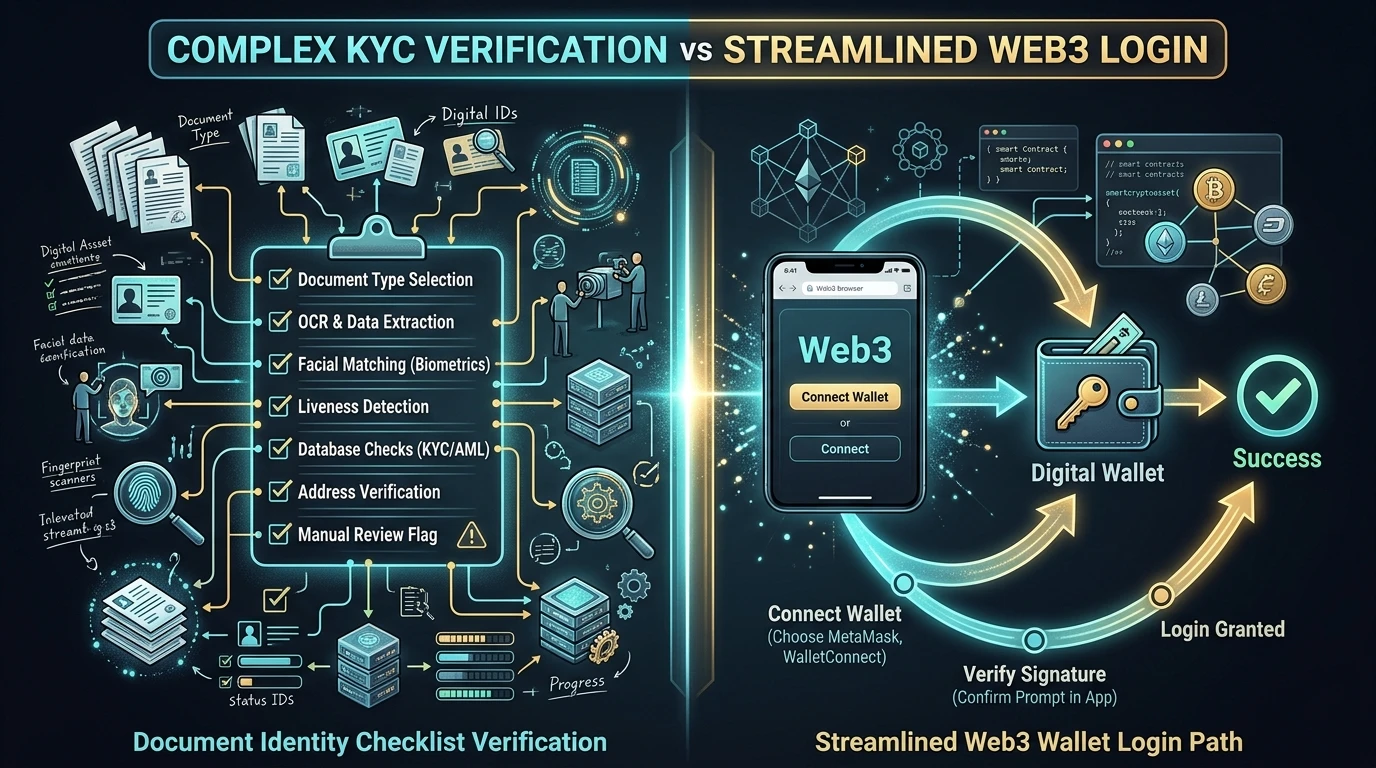
What the Split Means
Comparing KYC and No-KYC crypto casinos means comparing two compliance models, not two privacy labels. For Australian readers this matters because account checks, wallet rules, and withdrawal controls shift from platform to platform, sometimes even within the same operator over time.
We're covering this as an educational comparison only. No rankings, no operator promotion, no recommendation either way.
For educational purposes only, not financial or legal advice.
"No-KYC" sounds like it means no questions asked. It doesn't. A site might skip the paperwork at signup and still request documents or wallet evidence later, especially once withdrawals or unusual activity are involved. We see this pattern often enough that it's worth unpacking properly rather than taking either label at face value.
In this guide we look at why verification exists, how monitoring keeps running in the background regardless of the signup label, what deposits and cashouts actually look like in practice, and how this connects to how crypto casinos work.
No-KYC does not mean anonymous. The label usually describes lighter checks at sign-up. It does not rule out wallet screening, transaction monitoring, document requests, account limits, or a later source-of-funds review.
How KYC Works
A KYC casino wants proof of who you are before or during account use. Not because operators enjoy paperwork, but because they need enough information to catch account misuse and meet payment compliance duties. It's a risk-based review more than a single checkbox.
Why It Exists
Standard verification usually involves:
- photo identification
- a selfie or facial check
- proof of address
- confirmation that a payment method or wallet belongs to you
- source-of-funds information
- source-of-wealth evidence in higher-risk cases
Some operators also run transaction screening and anti-money laundering checks. Systems identify suspicious behaviour that includes sudden changes in deposit amounts, multiple transactions from third-party sources, or rapid transactions among various wallet accounts.
Suspicious activity can result in additional inquiries being made or a manual review of the activity. The operator may ask where funds came from, why a transaction was made or how control of a wallet can be demonstrated.
This is the common shape of the process, not a rulebook for any specific site. Document standards, review steps and account triggers differ between operators.
When It Shows Up
Checks land at signup, before the first deposit, when account details change, or right before a withdrawal clears.
Easy onboarding feels good at first, but documents requested later can stall access to your own funds or freeze the account mid-review. Unconfirmed details might mean limited deposits, paused withdrawals, or a locked login until it's sorted.
No universal withdrawal threshold triggers verification across every operator. Some services publish limits in their terms, while others rely on internal risk rules that are not shown as one fixed figure. This is why it is worth checking the verification and withdrawal clauses before depositing.
What No-KYC Usually Means
In marketing terms, "No-KYC" means lighter checks up front, not zero compliance. A platform might let you in with just an email or a connected wallet before any documents get requested. That's the appeal behind "crypto gambling without verification" or "no ID verification casinos."
But the label has a ceiling. Some services still monitor activity afterwards through:
- transaction screening
- withdrawal thresholds
- location checks
- wallet-risk signals
- changes in deposit or withdrawal behaviour
An account can go from casual access to a full review fast if deposits spike or withdrawals look off.
Reduced upfront verification is not the same as zero compliance. A privacy-focused casino might ask less at signup and still run wallet screening, account limits, or holds you never see until you hit one.
The question worth asking isn't whether a platform is fully anonymous. It's when checks show up and what sets them off. Money moving out tends to get noticed even on wallet-only accounts.
Readers assessing transparency should also separate identity checks from game-result verification. Our guide to provably fair systems explains what cryptographic fairness tools can verify and what still depends on the operator.
Where the Two Models Meet
The gap is widest at signup. KYC wants identity details early; No-KYC might start with nothing but an email or a wallet connection. Once funds start moving, though, both models run through the same machinery:
- withdrawal checks
- account reviews
- suspicious-activity flags
- wallet screening
- source-of-funds requests
- enforcement of account terms
Timing is the real difference. KYC collects documents before full access or before a withdrawal clears. No-KYC pushes that same step later, until behaviour changes or a withdrawal request trips internal rules, at which point you're looking at the same ID requests and source-of-funds questions either way. Withdrawals can bring extra checks under either model, and inaccurate details or a terms breach restricts the account regardless of which one you started under.
What Stays the Same Once Money Moves
Past onboarding, the models converge. Platforms with real AML controls keep reviewing unusual patterns and rechecking information as risk changes, comparing deposits and cashouts against account history rather than treating the first signup step as the whole story.
Obligations look similar on both sides. You're expected to give accurate details and use wallets or payment methods you can explain. Operators keep records, review suspicious activity and apply their terms consistently, at least in theory.
Withdrawal requests often get more attention than deposits because this is when funds leave the platform. The review may happen before the transaction is sent to the blockchain, so a pending withdrawal may not have a transaction ID yet.
Australian Law and Support Tools
Under the Interactive Gambling Act 2001, the federal rules focus on companies that offer or advertise gambling services to people in Australia. ACMA states that prohibited services include online casinos and wagering services that do not hold an Australian licence. This means the legal analysis centres on the service, the operator and how it is offered, rather than on the word "crypto" by itself.
A crypto payment option does not determine whether a service complies with Australian law. The product category, operator arrangements, advertising and availability to Australian customers all matter.
ACMA continues to investigate operators and block websites found to be in breach of the Interactive Gambling Act. In the October to December 2025 quarter, it reported 69 breaches and referred 133 websites for blocking, showing that enforcement remains active rather than theoretical.
For a closer examination of the operator-focused framework, see our guide to crypto casino legality in Australia.
BetStop is the National Self-Exclusion Register for Australian-licenced online and phone wagering services. It does not cover every casino-style service available online. Gambling Help Online and the National Gambling Helpline provide free, confidential support 24 hours a day on 1800 858 858.
For educational purposes only, not financial or legal advice.
No-KYC and wallet-led services can make self-exclusion harder to manage if identity-linked account controls are limited. Deposit limits, cooling-off settings and account-level exclusions may also differ from those used by locally licenced wagering providers.
Deposits, Reviews and Cashouts
Wallet-based gambling can look simple on screen. Underneath, there is a chain of separate steps.
A deposit starts when coins are sent to an address generated by the service. The transfer is recorded on the selected blockchain, waits for the required network confirmation, and is then matched to the account. The operator may also apply internal screening before the balance is credited.
There is no standard confirmation count across every coin or platform. The required figure depends on the network and the operator's crediting policy. Readers should check the cashier or payment terms for the stated number rather than assuming one common threshold.
A wallet or deposit pattern that does not fit the account history can pause crediting and trigger follow-up questions. Examples include frequent third-party transfers, funds moving rapidly across several addresses, or activity that differs sharply from previous use.
An operator might then ask for:
- evidence of wallet ownership
- an explanation of the transaction
- source-of-funds documents
- identity information
- details about a linked payment method
Skipping KYC at sign-up does not remove the possibility of that review. It changes when the conversation may happen.
Why Withdrawals Receive More Scrutiny
Withdrawals often receive closer review because that is when value leaves the platform. Limits may differ by coin, network, account status, or internal risk settings. Some services raise limits only after further verification. Others do not publish one universal trigger and assess the request against account history.
Processing time can include:
- account and wallet review
- internal approval
- transaction broadcast
- blockchain confirmation
- crediting by the receiving wallet or exchange
No single processing range applies across every operator. A platform's internal review may take longer than the blockchain transfer itself, while congestion can add more time after broadcast. Our explanation of crypto casino withdrawal processing separates those stages without promising a fixed payout window.
Moving between AUD and crypto through CoinSpot or Swyftx adds another identity and processing layer before money reaches a bank account. A hold can occur at the casino, during the blockchain transfer, or while converting the asset back into AUD.
Keeping the transaction ID, wallet addresses, date, asset amount, and AUD value can also help with personal records and possible ATO capital gains tax considerations when crypto is later disposed of.
How Internal Rules Shape Access
Internal rules shape day-to-day experience more than the signup label ever does. Compliance lives in legal interpretation, account friction, document requests, and the exact point where a platform decides a routine action needs a second look. A deposit that clears instantly can still sit behind a slow withdrawal if the wallet activity doesn't match what the operator expects.
Terms enforcement runs on the same logic. An account might get paused, asked for wallet evidence, or limited during a review, and whether support can actually explain that hold when you ask matters as much as the hold itself.
A Curaçao or Anjouan gaming licence does not explain an operator's complete verification process, withdrawal controls, account restrictions, or dispute handling. Those details usually sit in the terms, verification policy, withdrawal rules, and responsible gambling information.
The useful checks are practical:
- Is the verification policy visible before deposit?
- Does the service explain when documents may be requested?
- Are withdrawal limits and review stages published?
- Is wallet ownership addressed in the terms?
- Can support explain a hold in specific language?
- Are safer gambling controls clearly available?
A licence reference is one detail. It is not a substitute for reading the rules that govern the account.
What Matters When Comparing
KYC and No-KYC are two entry points into the same compliance system, not two different systems. One front-loads the paperwork, the other delays it until withdrawals or unusual activity force the issue. Neither label tells the whole story on its own, and we'd rather you hear that from us now than find out from a stalled withdrawal.
Before using any service, check what it actually expects regarding:
- identity documents
- wallet ownership
- source of funds
- withdrawal conditions
- account restrictions
- legal and licence information
- safer gambling controls
- access to customer support
We would rather readers understand these requirements before depositing than discover them while a withdrawal is pending. More on Australian crypto casino regulations in our crypto casino basics guide.
Know the checks before you hit them, not while you're waiting on a withdrawal wondering why it stalled.
Frequently Asked Questions
What does KYC mean at a crypto casino?
KYC is an abbreviation for "Know Your Customer". It may involve showing your identity, proof of address, a selfie, or even proof of ownership of the payment or wallet methods being used.
Does No-KYC mean fully anonymous?
No. It usually means fewer checks when you sign up. The operator may still screen wallets, monitor transactions, review withdrawals, or ask for documents later.
Can a No-KYC casino ask for ID later?
Yes. The operator may ask for ID or proof of where your funds came from when reviewing a withdrawal, checking unusual activity, or applying its terms.
Do KYC casinos process withdrawals faster?
Not always. Withdrawal times can depend on account verification, operator authorisation, traffic, and blockchain confirmation. There is no specific period that fits all services.
Are crypto casinos legal in Australia?
It varies from one service provider to another. The Interactive Gambling Act 2001 mainly restricts those who offer illegal online gambling services to persons within Australia. ACMA is responsible for enforcing these rules.
Does BetStop cover No-KYC crypto casinos?
Not always. BetStop covers Australian-licensed online and phone wagering providers. It does not automatically cover every offshore or casino-style website available online.
Where can Australians get gambling support?
Gambling Help Online provides free and confidential services in Australia at any time of the day. It is also possible to contact the National Gambling Helpline on 1800 858 858.